
Psychiatric Prison
The state calls it
A "32-bed forensic mental health facility"
What it really is
A psychiatric prison built to grow, on a 114-acre lot
This affects all of us
Near West Elementary. No vote. No tax income for Laurel.
Checking in?
Status: Public Comment Periods Closed
Both the April 22 and June 2 public comment periods have closed.
This project is still ongoing and this page is due for a fuller update. In the meantime, the archived hearing pages and related materials are linked below.
The Facility
What the state announced
According to DPHHS and BOI, this is a 32-bed secure psychiatric facility for people in the criminal justice system: those awaiting competency evaluations, those found Unfit to Proceed (UTP), and those convicted under mental illness provisions (NGRI, GBMI). Patients are court-ordered. They cannot leave voluntarily. DPHHS would operate the facility under a minimum 20-year lease.
What their own documents show
Expansion is a siting condition, not a possibility.
DPHHS Director Brereton's October 6, 2025 letter to BOI states:
"communities and stakeholders should be aware that any site selected must allow for potential expansion in future years."
Laurel was never asked whether it accepted this condition.
It is designed to convert to a general psychiatric hospital at DPHHS's discretion.
"The facility would be designed with scalability in mind should the agency determine a need to leverage beds for the civil population in the future."
— DPHHS, Building a Foundation for Future Generations, October 2025
Civil psychiatric patients are individuals involuntarily committed, not criminal defendants. The patient population can shift at DPHHS's discretion with no community vote required.
Legitimate community concerns
Escape and elopement risk near a school
The patient population includes individuals found Not Guilty by Reason of Mental Illness (NGRI) or Unfit to Proceed (UTP) for serious violent crimes, including homicide and assault. Forensic psychiatric facilities are secured, but elopement and escape incidents occur at such facilities nationally. This facility would be located near West Elementary School and adjacent to Laurel's residential neighborhoods.
Visitor traffic reflects the patient population
A significant share of the patient population includes individuals with histories of substance abuse and involvement in associated criminal networks. Forensic facilities operate regular visitation programs, and the visitors reflect that reality. This is not about stigmatizing mental illness. It is an honest acknowledgment that the people coming and going from this facility, on a regular schedule, through a neighborhood adjacent to an elementary school, are not a typical cross-section of the community.
Guaranteed expansion with no community vote at any stage
Accepting expansion is a stated condition of site selection. Phase 2 doubles the facility to 64 beds with no legislative or community approval required. Montana law does not require DPHHS to seek local consent before expanding a facility it operates on state-owned land. And there is no guarantee that expansion stops at a larger psychiatric facility. Once the state owns this land, there is nothing preventing the addition of jails, prisons, group homes, prerelease programs, outpatient services, or other support buildings. The state would not be required to consult the public on any of it.
No guarantee on what the facility becomes
DPHHS's own documents confirm the facility is designed to pivot between forensic and civil psychiatric populations at their discretion. Montana law does not restrict what patient populations can be housed there, nor does it prevent the facility from being adapted for other institutional uses, including transitional housing, group homes, or community corrections programs. No binding commitment, current or future, prevents this. Future DPHHS directors, legislatures, and budget pressures are not bound by promises made in 2026.
Property value impact on surrounding homes
Research published in the Journal of Real Estate Research documents that stigma-producing institutional uses reduce residential property values by 10% to 20% within approximately one mile, with the sharpest impact on homes closest to the facility. For a $500,000 home in today's Laurel market, that is a potential loss of $50,000 to $100,000 in value. Buyers who have options will simply choose somewhere else. Laurel's licensed real estate community has already reported clients inquiring about selling in the surrounding area since this project became public. In residential markets, perception drives behavior. Once a use carries stigma, that perception does not reset.
Strain on public services and infrastructure with no offsetting revenue
A 90-to-100-person staff operating around the clock, plus a patient population that includes individuals in acute psychiatric crisis, will generate real and ongoing demands on Laurel's police, fire, and emergency medical services. The facility's staff and visitors will drive on our roads daily. Roads, public works, and the broader infrastructure improvements that growing communities depend on are funded through property taxes. The state pays none. Every year the facility operates, it draws on Laurel's public infrastructure and returns nothing to the tax base that maintains it.
Sources: DPHHS/BOI joint plan to Budget Director, November 26, 2025; DPHHS Director Brereton letter to BOI, October 6, 2025; DPHHS FAQ and planning document Building a Foundation for Future Generations, October 2025; BOI buy-sell agreement, January 13, 2026.
The Location
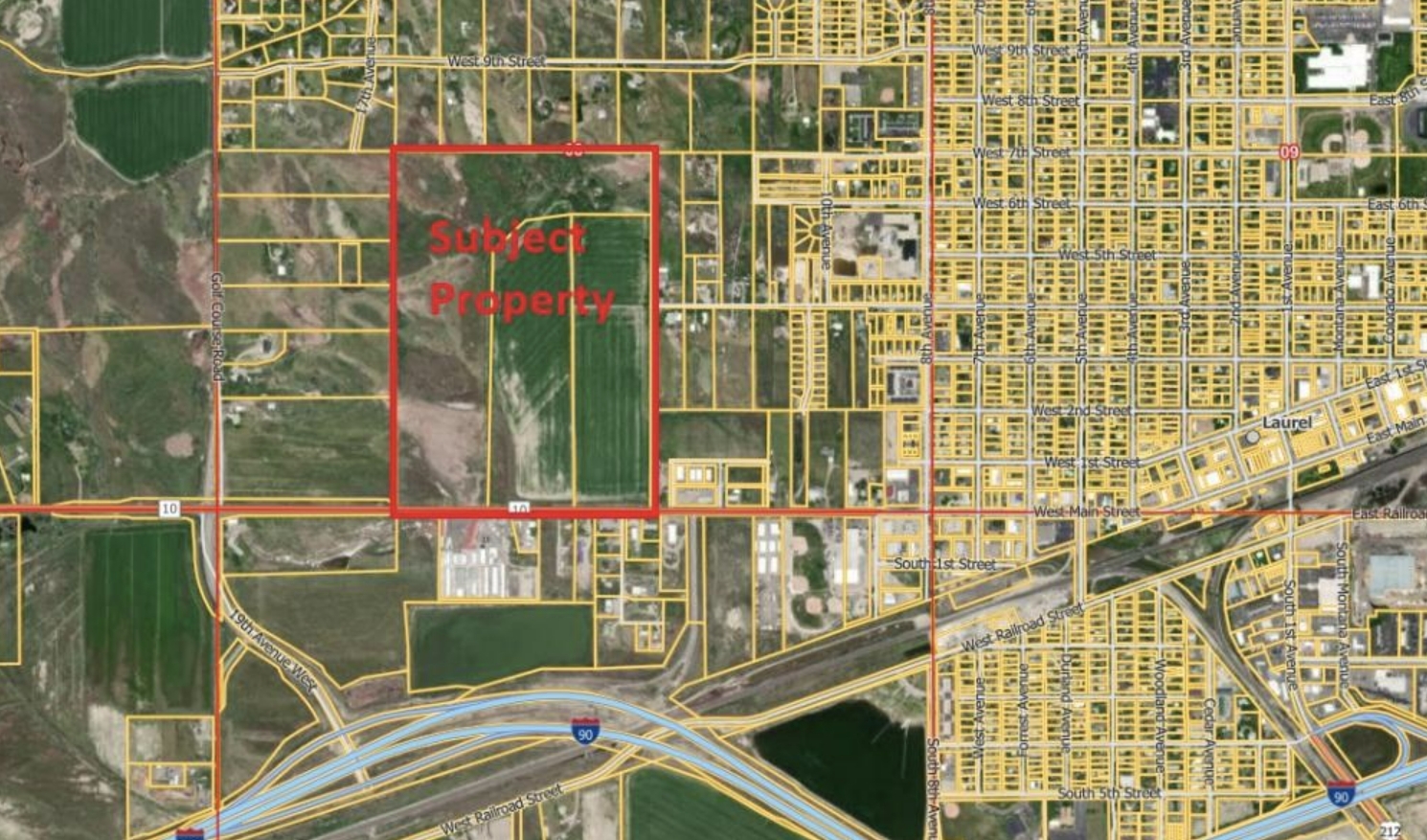
The proposed site is approximately 114 acres at 1425 US Highway 10, on the western edge of Laurel, currently outside city limits. It is near West Elementary School. The legal description is Lots 1–3, Block 1 of the Rossmoor Subdivision, Yellowstone County.
This land was not formally nominated through the state's Due Diligence Questionnaire process. Markegard pointed the state toward the Highway 10 site informally during a summer site tour. The state selected it anyway, outside any formal nomination or community input process.
This is Laurel's growth path. It is the only direction the city can expand to add housing and build our community. The city's growth policy designates this area for residential development. At standard density, 114 acres could support approximately 400 homes and more than 1,000 new Laurel residents, along with light commercial development along Highway 10. Those residents would shop here, pay property taxes here, and send their children to our schools.
The psychiatric prison produces none of that. As a state-owned facility, it is exempt from property taxation, contributing zero to the city, county, or school district. The specialized staff it requires will most likely live in Billings, paying their taxes and spending their wages there while using Laurel's infrastructure. The facility also requires a wide security buffer, permanently removing that land from any future use. Laurel would bear the costs with none of the return.
There is a better option
If the state genuinely believes Laurel is the right location for this facility, they could build it on state land they already own just beyond the Laurel Container Site. That location offers the same workforce access, more land, no proximity to schools or neighborhoods, and sits well out of sight from the road. The infrastructure improvements required to extend water and sewer to that site would not just serve the facility. They would open up additional land for future community growth, giving Laurel a more stable tax base and a stronger foundation for expansion. The Highway 10 site takes from Laurel. The alternative gives something back.
The Process
How Laurel was selected
Two eastern Montana communities submitted comprehensive formal proposals with documented community support through the state's Due Diligence Questionnaire process. Laurel submitted nothing through that process. Behind the scenes, our CAO and Mayor communicated privately with BOI on multiple occasions, laying the groundwork for a selection that was never put before the community or City Council. The letter the state calls Laurel's application was solicited by BOI Executive Director Dan Villa, who texted Markegard asking him to submit it, offering to buy him a beer if he sent it that afternoon. Kurt provided the November 17 letter seven days after the proposal deadline. It was never a legitimate submission. Laurel was selected anyway. This betrayal of our community's trust has prompted a demand for reform, transparency, and accountability, including the recall of Mayor Waggoner.
What they promised vs. what they delivered
Governor Gianforte, BOI, and DPHHS promised robust community engagement and consideration. What they delivered: no formal community input before site selection, a buy-sell agreement signed before City Council was briefed, and a MEPA environmental review initiated only after community opposition forced their hand. Every step of this process has been marked by disregard for proper channels, transparent communication, and the community's right to meaningful participation.
When BOI Executive Director Dan Villa wanted to communicate with City Council about this project, he did not request agenda time. He called in during public comment, a period reserved for citizens to address the council, one that does not allow questions or discussion. He used it to drop tidbits of information on a massive, controversial project and then hang up. The governor's office described this to legislators as Villa "presenting to City Council." Councilmember Jodi Mackay wrote directly to the Governor: "His cowardly use of 'Public Comment' is completely inappropriate and disrespectful to our City Council and our citizens. As Governor of this great state, you should be appalled by the disrespect shown to your constituents." The Governor did not respond.
The state's response to the community
The community sent letters and correspondence to Governor Gianforte for months and received only form letter responses. On March 17, 2026, the governor indicated to Representative Deming and Senator Ricci that he would be willing to meet with Laurel CARED. On March 19, he said he would look at dates and follow up. On March 31, his office formally declined. The stated reason: because Laurel CARED had requested a Department of Justice investigation into DPHHS and BOI, the governor's office cited active legal concerns and withdrew the offer. The community asked for accountability. The governor's response was to stop talking to us. BOI has set a public hearing in Laurel as required under the Montana Environmental Policy Act. The community now has a formal opportunity to put its testimony on the record.
The MEPA environmental review should have happened before the site was selected and a buy-sell agreement was signed, not after. The community made this clear from the beginning. Early in the process, BOI and DPHHS agreed to hold community meetings, then canceled them. Their stated preference was for a closed-door meeting with city representatives, not the people of Laurel. Before legislative oversight committees, the pattern has been consistent: Intentionally misleading comparisons and statements. Arrogant dismissal of community concerns. Procedural violations intended to keep the community in the dark. DPHHS used proximity maps of a children's hospital and a voluntary civil psychiatric unit to normalize this siting, knowing those facilities share no relevant characteristics with a secured forensic facility. One arm of state government is funding Laurel's housing growth strategy under state law. Another is acquiring the only land available to achieve it. They have shown zero respect for the community of Laurel, for our City Council, or for the public processes that exist to protect communities like ours.
Take action now
Demand Accountability from Governor Gianforte
Ask Governor Gianforte to hold a public Yellowstone County community event and answer Laurel residents directly.
Take Action NowWhere Should I Show Up Next?
Find upcoming meetings and events tied to the psychiatric prison, including BOI, state oversight, county, and local public meetings.
Open CalendarDemand Accountability from Governor Gianforte
Ask Governor Gianforte to hold a public Yellowstone County community event and answer Laurel residents directly.
Take Action NowWhere Should I Show Up Next?
Find upcoming meetings and events tied to the psychiatric prison, including BOI, state oversight, county, and local public meetings.
Open CalendarWhere Should I Show Up Next?
Find upcoming meetings and events tied to the psychiatric prison, including BOI, state oversight, county, and local public meetings.
Open CalendarDemand Accountability from Governor Gianforte
Ask Governor Gianforte to hold a public Yellowstone County community event and answer Laurel residents directly.
Take Action NowArchive
April 22 Public Hearing
ArchivedThe first MEPA public hearing and comment period on the proposed facility. Closed.
June 2 Public Hearing
ArchivedThe state's revised final environmental assessment and comment period, covering the 64-bed buildout and updated water, sewer, and groundwater claims. Closed.
Demand Accountability from Governor Gianforte
Governor Gianforte's 56 County Tour passed through Yellowstone County without holding the public town hall CARED requested. We'll be updating this page with where things stand.